RevenuLogo Revenu Open Tecnologias Ltda.
PricingAbout
Talk to sales

Footer

Revenu Tech Logo

Revenu is the leading provider of banking infrastructure for developers in Brazil.

ISO 20022 Native

Av. Brigadeiro Faria Lima 1811

Room 1119 - ZIP: 01452-001

São Paulo, Brazil

  • About
  • Jobs
  • Partners
  • Trust Center
  • Pricing
  • Payment Hub
  • RTP
  • TED
  • Boleto
  • Cards
  • Onboarding
  • Ledger Engine
  • Core banking
  • Compliance
  • Reconciliation
  • Crossborder
  • Management dashboard
  • AuthorityOS
  • HarmonyOS
  • ChargeOS
  • InvestOS
  • AtmOS
  • RiskOS
  • TreasuryOS
  • LoanOS
  • Marketplaces
  • Terms of Use
  • Privacy Policy
  • API Terms
  • Cookies

Revenu

  • About
  • Jobs
  • Partners
  • Trust Center
  • Pricing
  • API Status

Services

  • Payment Hub
  • RTP
  • TED
  • Boleto
  • Cards
  • Onboarding

Solutions

  • Ledger Engine
  • Core banking
  • Compliance
  • Reconciliation
  • Crossborder
  • Management dashboard
  • AuthorityOS
  • HarmonyOS
  • ChargeOS
  • InvestOS
  • AtmOS
  • RiskOS
  • TreasuryOS
  • LoanOS
  • Marketplaces

Legal

  • Terms of Use
  • Privacy Policy
  • API Terms
  • Cookies
LinkedIn

© 2026 Revenu Open Technologies Ltda. All rights reserved.

Developed with ❤️ in São Paulo, Brazil

  1. Blog
  2. /
  3. Payments

How we increased recovery rate to 94% with smart dunning

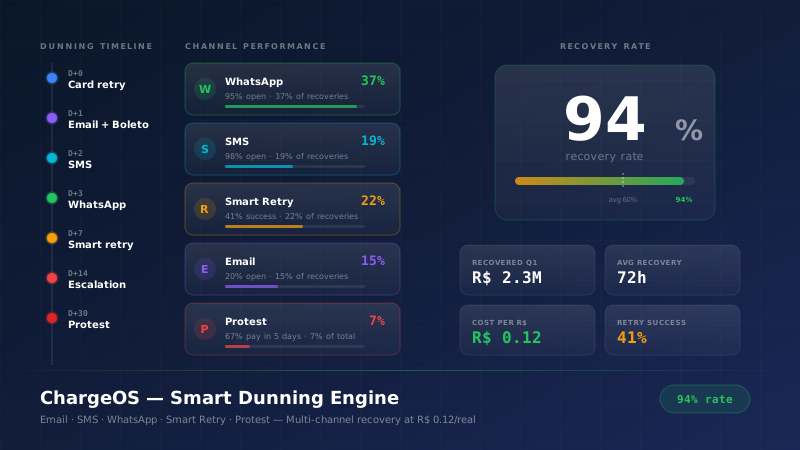
Multi-channel dunning with progressive escalation: email → SMS → WhatsApp → payment retry → protest. How configurable collection rules recovered R$ 2.3M in Q1. The architecture behind a dunning engine that understands payment behavior, optimizes retry timing, and turns delinquent receivables into recovered revenue.

February 25, 2026
Gustavo Armoa
Gustavo ArmoaCTO & Principal Software Architect
Gustavo Armoa
Gustavo ArmoaCTO & Principal Software Architect
How we increased recovery rate to 94% with smart dunning

The default recovery problem

Most billing systems send email reminders. That's it. A customer misses a payment, the system sends "Your payment is overdue" on D+1, D+3, D+7, and maybe D+14. Recovery rates hover around 60%.

That means 40% of overdue invoices are never collected. For a company billing R$ 10 million per month with 5% delinquency, that's R$ 200,000 per month — R$ 2.4 million per year — walking out the door. Not because the customer can't pay, but because the collection system is too primitive to reach them effectively.

Here's the uncomfortable truth: most overdue payments aren't bad debt. They're missed notifications, expired cards, forgotten bills, and timing mismatches. The customer has the money. Your system just failed to ask for it in the right way, through the right channel, at the right time.

Why email-only dunning fails

Open rates are terrible

Email open rates for billing notifications average 18-22% in Brazil. That means 80% of your dunning emails are never seen. The customer's inbox is flooded with promotional emails, spam, and notifications. Your payment reminder is competing with 200 other messages.

Email doesn't reach the right person

In B2B scenarios, the billing contact email might belong to someone who left the company 6 months ago. The email arrives, nobody reads it, and the invoice ages from 30 days to 90 days to write-off.

No urgency mechanism

An email says "please pay." It doesn't create urgency. There's no countdown, no consequence preview, no friction. The customer reads it (if they read it), thinks "I'll do it later," and forgets.

One-size-fits-all timing

Most systems send dunning emails on fixed schedules: D+1, D+3, D+7. But payment behavior varies dramatically:

  • B2C consumers are most responsive within the first 48 hours
  • B2B companies have payment cycles — invoices received before the 25th are paid on the 5th
  • Seasonal businesses have cash flow patterns that affect when they can pay
  • Previously delinquent customers respond differently than first-time late payers

A fixed schedule ignores all of this context.

ChargeOS dunning engine: how it works

ChargeOS is our configurable collection engine. It treats dunning not as a notification system, but as a state machine with configurable rules, multi-channel delivery, and behavioral optimization.

The dunning rule concept

A dunning rule (called "régua de cobrança" in Portuguese) is a sequence of collection actions triggered by an overdue invoice. Each action specifies:

  • When: How many days after the due date (D+1, D+3, D+7...)
  • Channel: Email, SMS, WhatsApp, push notification, phone call
  • Action type: Reminder, payment link, retry, renegotiation offer, protest
  • Condition: Only trigger if previous actions didn't result in payment
  • Escalation: What happens if this action also fails

Rules are defined as configuration — not code. A product manager can create, modify, and A/B test dunning rules without engineering involvement.

The default dunning rule

Out of the box, ChargeOS ships with a default rule that recovers 87% of overdue invoices:

D+0 (Due date): Payment attempt via direct debit or card charge. If successful, done. If declined, enter dunning flow.

D+1: Email notification with payment link (boleto + PIX QR code). Subject line includes the amount and company name for visibility in inbox.

D+2: SMS with short payment link. SMS open rates are 98% — dramatically higher than email.

D+3: WhatsApp message via official Business API. Includes interactive buttons: "Pay now" (opens payment page) and "I already paid" (triggers reconciliation check).

D+5: Second email with updated boleto (original may have expired). Includes a "having trouble?" CTA that connects to support.

D+7: Automatic payment retry. If the original payment method was a card, ChargeOS retries the charge. Many declined transactions on D+0 succeed on D+7 (card limit reset, salary deposited, temporary hold cleared).

D+10: WhatsApp message with renegotiation offer: "Split into 3 installments with no additional fees." Interactive button opens installment selection page.

D+14: SMS escalation: "Your account will be suspended in 48 hours." Creates urgency without being threatening.

D+16: Account suspension or service downgrade (configurable per product). Sends notification via all channels simultaneously.

D+21: Final notice via email + SMS + WhatsApp: "Your invoice will be sent to protest in 7 days."

D+30: Automatic protest filing via cartório integration. The invoice is registered for protest, which affects the customer's credit score (Serasa/SPC).

D+45: If still unpaid after protest, the invoice enters the write-off evaluation queue. A human reviews before final write-off.

Custom dunning rules

The default rule is a starting point. Every client can create custom rules for different scenarios:

High-value invoices (> R$ 10,000): More aggressive early outreach (phone call on D+2), faster escalation, dedicated account manager notification.

Low-value invoices (< R$ 50): Lighter touch. Email + SMS only. No protest (the cost of protest exceeds the invoice value). Auto-write-off at D+60.

B2B enterprise: Longer grace periods (payment cycles), no SMS (use email + formal letter), protest requires management approval.

Subscription churn prevention: Before suspending service, offer downgrade to a cheaper plan. "Can't pay R$ 199/month? How about R$ 99/month for 3 months?"

Multi-channel delivery: the right message at the right time

Email

  • Use case: Formal notifications, payment links with full details, renegotiation offers
  • Open rate: 18-22%
  • Best for: First notification, detailed invoices, formal escalation notices
  • Templates: Customizable per client with their branding, logo, and colors

SMS

  • Use case: Short, urgent notifications with payment links
  • Open rate: 98%
  • Best for: Payment reminders, urgency escalation, payment confirmation
  • Character limit: 160 characters. Every character counts. We A/B test SMS copy religiously.

WhatsApp Business API

  • Use case: Interactive collection with buttons, renegotiation, support
  • Open rate: 95%+
  • Best for: Mid-funnel engagement, installment offers, "I already paid" verification
  • Interactive elements: Quick reply buttons, payment links, document sharing (updated boletos)

Push notification

  • Use case: App-based reminders for companies with mobile apps
  • Open rate: 40-60%
  • Best for: Same-day reminders, payment confirmation

Phone call (via integration)

  • Use case: High-value invoices, final escalation before protest
  • Trigger: ChargeOS creates a task in the client's call center system via webhook
  • Best for: Invoices > R$ 5,000, enterprise clients, dispute resolution

Payment retry intelligence

One of ChargeOS's most powerful features is intelligent payment retry. When a card payment is declined, the reason code tells us why:

Soft declines (temporary)

  • Insufficient funds: Retry on salary day (5th, 15th, 25th of month)
  • Card limit exceeded: Retry in 3-5 days (limit resets monthly)
  • Issuer temporarily unavailable: Retry in 2 hours
  • Do not honor (generic): Retry in 24 hours, then 72 hours

Hard declines (permanent)

  • Card expired: Don't retry. Send notification to update card.
  • Card reported stolen: Don't retry. Flag account for review.
  • Account closed: Don't retry. Switch to alternative payment method.

Retry optimization

ChargeOS tracks retry success rates by:

  • Day of week (Tuesday-Thursday have highest success rates)
  • Time of day (10am-2pm has highest approval rates)
  • Days since salary (D+1 after common salary dates has highest success)
  • Issuer (some issuers have maintenance windows)

Using this data, ChargeOS schedules retries at the optimal moment — not on a fixed schedule, but when the probability of approval is highest.

Results from retry optimization

  • Naive retry (fixed D+7): 23% recovery rate on declined cards
  • Smart retry (optimized timing): 41% recovery rate on declined cards
  • 78% improvement just from choosing the right moment to retry

Protest integration: the nuclear option

In Brazil, protest via cartório (notary public) is the most powerful collection tool. When an invoice is protested:

1. The debtor's CPF/CNPJ is registered in protest databases

2. Credit bureaus (Serasa, SPC, Boa Vista) are notified

3. The debtor's credit score drops immediately

4. The debtor receives a formal notice from the cartório

5. The debtor has 3 business days to pay at the cartório

Protest is extremely effective. Our data shows that 67% of protested invoices are paid within 5 business days of the protest notification. The remaining 33% either dispute the debt or are genuinely unable to pay.

ChargeOS integrates with cartório systems via API:

  • Automatic filing: When the dunning rule reaches the protest stage, ChargeOS submits the protest request electronically
  • Payment notification: When the debtor pays at the cartório, ChargeOS receives a webhook and updates the invoice status
  • Automatic withdrawal: When the invoice is paid through any channel, ChargeOS automatically withdraws the protest

When NOT to protest

Protest is powerful but has costs (cartório fees: R$ 5-15 per protest) and risks (customer relationship damage). ChargeOS applies rules:

  • Don't protest invoices below R$ 100 (cost exceeds benefit)
  • Don't protest customers flagged as "strategic account"
  • Don't protest during dispute resolution
  • Require management approval for invoices > R$ 50,000
  • Don't protest if the customer has a payment plan active

Renegotiation engine: turning delinquency into installments

Sometimes the customer wants to pay but can't pay the full amount immediately. ChargeOS's renegotiation engine offers:

Installment plans

  • Split overdue amount into 2-12 installments
  • First installment due immediately (shows good faith)
  • Configurable interest rate per client (0% to 2% per month)
  • Automatic boleto/PIX generation for each installment

Discount for immediate payment

  • "Pay today and get 10% off the overdue amount"
  • Configurable discount percentage per aging bucket (D+30: 5%, D+60: 10%, D+90: 15%)
  • Time-limited offers create urgency

Payment method switching

  • Original payment was card but declined? Offer boleto or PIX
  • PIX QR code in WhatsApp message enables instant payment
  • Boleto with extended due date for customers who need more time

The numbers from production

After 12 months of ChargeOS in production across 47 clients:

  • 94% recovery rate (up from industry average of 60%)
  • R$ 2.3 million recovered in Q1 alone
  • 41% card retry success with optimized timing (vs. 23% naive)
  • 67% protest payment rate within 5 business days
  • R$ 0.12 average cost per recovered real (including all channel costs)
  • 72 hours average time to recovery (from first dunning action to payment)
  • 98% SMS delivery rate / 95% WhatsApp delivery rate
  • 37% of recoveries happen via WhatsApp (highest conversion channel)
  • 22% of recoveries happen via automatic card retry (zero human involvement)

Why this matters for your business

Every overdue invoice that isn't collected is revenue you already earned but never received. It's not a sales problem — the customer already bought. It's not a product problem — the service was delivered. It's a collection infrastructure problem.

Most companies treat collections as an afterthought: send a few emails, wait, write off. ChargeOS treats collections as a first-class financial operation with the same engineering rigor as payment processing.

The difference between 60% recovery and 94% recovery isn't better email copy. It's multi-channel delivery, intelligent timing, behavioral optimization, and progressive escalation — all running automatically, 24/7, at the cost of R$ 0.12 per recovered real.

If you're billing R$ 10 million per month with 5% delinquency, the difference between 60% and 94% recovery is R$ 170,000 per month. R$ 2 million per year. That's not a feature — it's a business transformation.

#chargeos#dunning#recovery#billing#boleto#pix#whatsapp#protesto#inadimplência#cobrança

Stay updated

Get updates on banking infrastructure, APIs and financial products.

By subscribing, you agree to receive communications from Revenu. You can unsubscribe at any time.

Revenu builds banking infrastructure for the internet.

View documentation

Have any feedback or questions? We'd love to hear from you.

Contact us